

The Evolution of Moving Trucks: From Horse-Drawn Carriages to Modern Vehicles
How moving trucks evolved from horse-drawn wagons to climate-controlled fleets. Safebound operates 26-ft trucks across FL. Call 561-510-7191.

Last Updated: March 2026
Moving trucks went from horse-drawn wagons to GPS-tracked, air-ride-suspension vehicles in about 120 years. The changes weren't just mechanical. Each advancement in truck design changed what people could move, how far they could move it, and what condition their belongings arrived in. Understanding how moving trucks work today helps you evaluate whether a mover's equipment matches the job. Safebound Moving & Storage (USDOT 2900155) operates its own fleet of moving trucks out of West Palm Beach, Florida, and has completed 35,000+ moves across the continental United States. Get a free quote for your move.
From Horse-Drawn Wagons to Motorized Trucks
Before the automobile, household moves happened by horse-drawn wagon. A single wagon could carry roughly 2,000 pounds over short distances on unpaved roads. Long-distance moves required rail transport, with furniture loaded into freight cars and transferred by wagon at each end. Breakage rates were high because nothing was padded or secured.
The first motorized moving trucks appeared in the early 1900s. Ford's Model TT truck, introduced in 1917, could haul about a ton on paved roads. By the 1930s, purpose-built moving vans with enclosed cargo areas replaced open-bed trucks, and the long-distance moving industry began to take shape. National carriers founded in the late 1920s built networks of agents who shared truck capacity across state lines, establishing the framework for modern interstate moving.
The Interstate Highway System Changed Everything
Before 1956, cross-country moves followed a patchwork of state highways with varying speed limits, road conditions, and bridge weight limits. The Federal Aid Highway Act of 1956 created the Interstate Highway System, which standardized road widths, bridge clearances, and weight tolerances. Suddenly a moving truck could drive from Miami to Seattle on continuous highway.
Truck sizes grew in response. The standard moving van expanded from 20-foot bodies to 26-foot and eventually 53-foot trailers for long-haul routes. Air-ride suspension replaced leaf springs, reducing vibration damage to furniture and electronics during transit. Hydraulic lift gates eliminated the need to carry heavy items up ramps.
Modern Moving Truck Technology
Today's moving trucks carry features that would have been unimaginable a generation ago. GPS tracking lets dispatchers and customers monitor shipment location in real time. Air-ride suspension systems cushion cargo across thousands of miles of highway. Climate monitoring prevents heat and humidity damage to sensitive items like electronics, artwork, and musical instruments.
Truck interiors use tie-down systems, padded walls, and adjustable decking that allows crews to stack and separate shipments without cross-contamination on shared loads. Loading ramps are wider and rated for heavier equipment. Some fleets have shifted to diesel-electric hybrids for better fuel efficiency on urban routes.
What Safebound's Fleet Looks Like Today
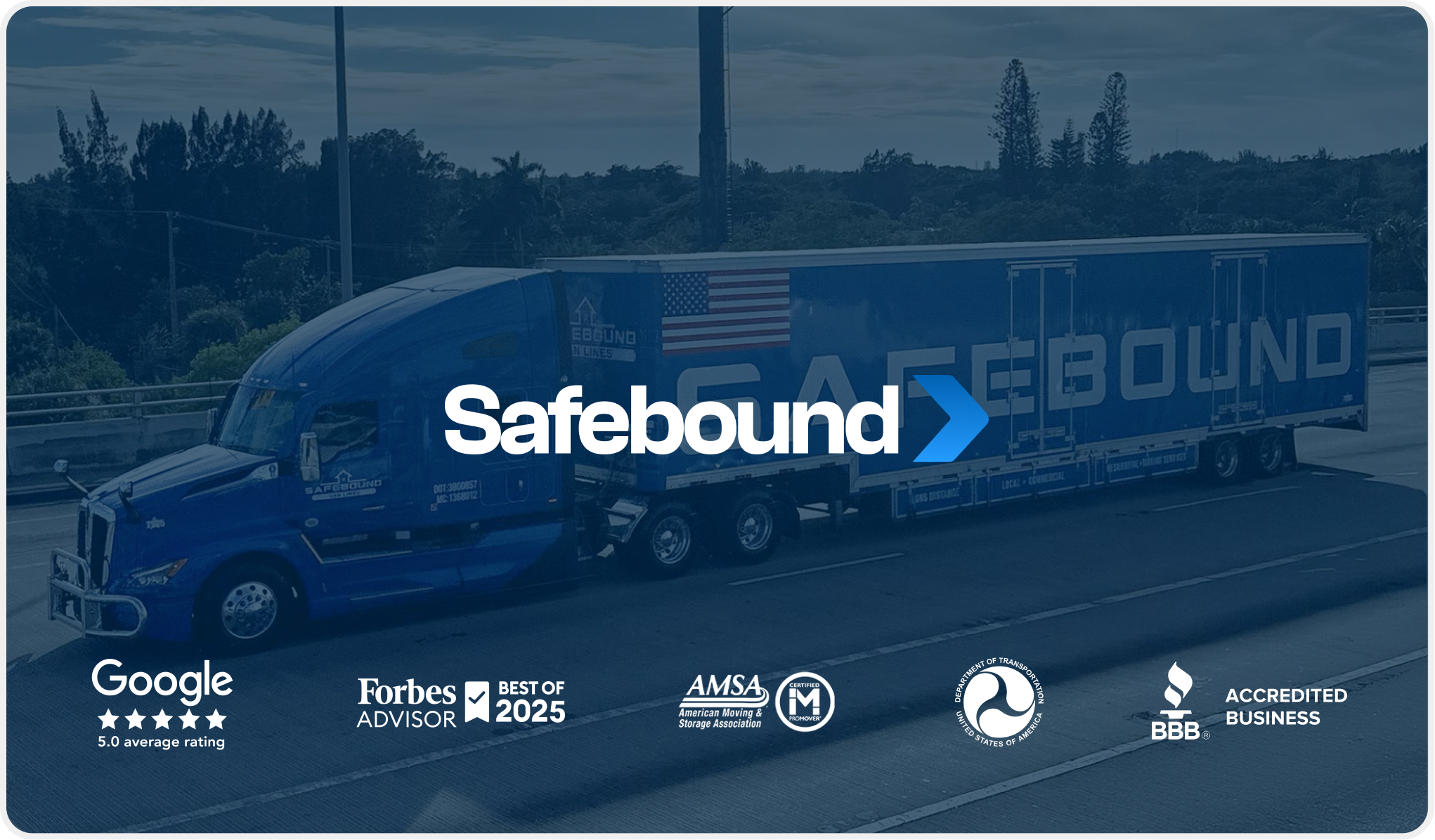
Safebound Moving & Storage operates its own trucks from its West Palm Beach headquarters at 6051 Southern Blvd. The fleet handles local moves throughout Palm Beach County, Broward County, and Miami-Dade County as well as long-distance moves across the continental United States under FMCSA authority MC MC00975408.
For local moves, Safebound dispatches 26-foot trucks equipped with loading ramps, moving blankets, floor protection, and tie-down systems. Crews carry tools for furniture disassembly and reassembly. Local rates start at $135 per hour for a 2-mover crew, $180 per hour for 3 movers, and $225 per hour for 4 movers, with a 3-hour labor minimum plus 1 travel hour on every job.
Long-distance moves use larger vehicles or dedicated space on route-specific trucks. All long-distance moves are priced as binding flat rates based on cubic footage with a 400 cubic foot minimum. Request a binding quote for your move.
Safebound Moving & Storage holds USDOT 2900155, MC MC00975408, and Florida license IM2839 with $750,000 in insurance coverage. BBB Accredited, ProMover Certified, AMSA Member, and Forbes Featured. License verification: fdacs.gov | safer.fmcsa.dot.gov
Frequently Asked Questions
What size truck do most movers use?
Most professional movers use 26-foot box trucks for local and regional moves. These trucks hold approximately 1,200 to 1,600 cubic feet of household goods, enough for a 3-4 bedroom home. Long-distance movers use 53-foot trailers that can carry multiple households on shared loads or a single large estate on a dedicated shipment. Safebound uses 26-foot trucks for local South Florida moves and larger vehicles for cross-country routes.
How much do movers charge in Florida?
Local movers in Florida typically charge $100 to $250 per hour depending on crew size and company. Safebound Moving & Storage charges $135 per hour for 2 movers, $180 per hour for 3 movers, and $225 per hour for 4 movers. All local moves include a 3-hour labor minimum plus 1 travel hour. Long-distance moves from Florida are priced as binding flat rates based on cubic footage. Call 561-510-7191 for a quote.
Does the type of truck affect my belongings' safety?
Truck quality directly affects cargo safety. Air-ride suspension reduces vibration damage over long distances. Padded interior walls prevent scratching on furniture surfaces. Tie-down systems secure items during turns and stops. Hydraulic lift gates reduce the risk of drops during loading. Ask your mover what type of trucks they operate and whether the vehicles are owned or rented, since rental trucks may lack professional moving equipment.
Should I rent a truck or hire movers?
Renting a truck saves money but requires you to handle all loading, driving, and unloading. A 26-foot rental truck costs $40 to $150 per day plus mileage and fuel. Professional movers cost more per hour but handle packing, loading, driving, unloading, and furniture reassembly. For homes with heavy furniture, tight staircases, or elevator access requirements common in South Florida condos, professional movers reduce the risk of property damage and personal injury.
What is air-ride suspension on a moving truck?
Air-ride suspension uses air-filled bags instead of metal springs to cushion the cargo area during transit. This system absorbs road vibrations and bumps that would otherwise transfer directly into your furniture and boxes. It matters most on long-distance moves where goods spend days on the highway. Items like flat-screen televisions, glass tabletops, and framed artwork benefit significantly from reduced vibration during cross-country transport.
How many cubic feet does a moving truck hold?
A standard 26-foot moving truck holds 1,200 to 1,600 cubic feet. A 16-foot truck holds approximately 800 cubic feet, suitable for a 1-2 bedroom apartment. A 53-foot trailer holds roughly 4,000 cubic feet. Safebound's crews assess your home during the quoting process to determine the correct truck size. Underestimating truck capacity means a second trip, which adds hours and cost on local moves.
Does Safebound own its trucks?
Safebound Moving & Storage operates its own fleet from its West Palm Beach headquarters. Owning the fleet means the company controls maintenance schedules, equipment quality, and availability. Movers who rent trucks for each job may encounter last-minute vehicle shortages or arrive with trucks lacking professional padding, tie-downs, or floor protection. Safebound's trucks are maintained and equipped for both local and long-distance household moves.
What happens if the truck breaks down during my move?
Professional moving companies carry roadside assistance and backup vehicle plans for breakdowns. On local moves, Safebound dispatches a replacement truck from its West Palm Beach fleet. On long-distance moves, the company coordinates roadside repair or transfer to another vehicle to minimize delivery delays. Your belongings remain insured under the valuation coverage selected on the Bill of Lading regardless of any mechanical issues during transit.
Ready to move? Call 561-510-7191 or get a free quote online. Safebound Moving & Storage has completed 35,000+ moves with a 4.9-star rating from 2,401 Google reviews. BBB Accredited and ProMover Certified. Available Monday through Friday 8:30am to 9pm and Saturday through Sunday 10am to 6pm.
or Call Now (561) 559-5725
Keep Exploring
Keep the learning going with these posts.
