

Illinois Long Distance Movers
Long-distance moving across the Midwest and beyond. Chicago to Detroit, Indianapolis, Milwaukee or Columbus, or out to the Northeast, the Southeast, Texas and the coasts. Every estimate is in writing before you commit.
Let's Get You Moving - Get Your Free Quote In 3 Quick Steps!


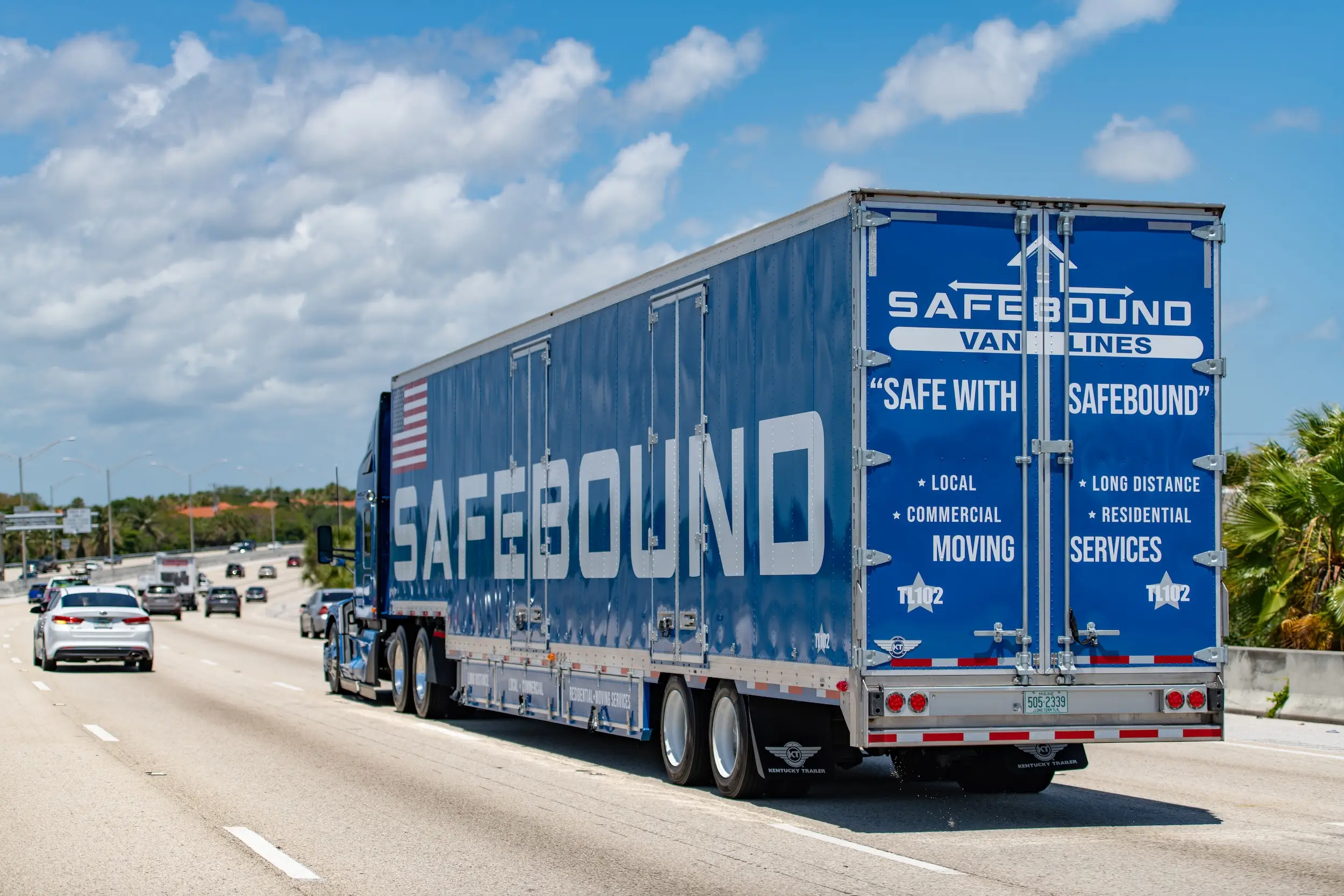
Safebound Moving & Storage handles long-distance and interstate moves for Illinois households. The center of gravity is the Chicago metro — the city itself, the collar counties and the suburbs out through Naperville, Schaumburg and Joliet — alongside Rockford, Peoria, Springfield, Champaign-Urbana and the Metro East.
We are registered with the U.S. Department of Transportation for interstate household goods moves, and every estimate is in writing before you commit to anything. Interstate moving is priced on the volume of what you are shipping, access and mileage, not on a flat rate pulled off a web page.
Illinois is the state where the gap between a local move and a long-distance one is easiest to miss. Chicago to Milwaukee is about 90 miles and crosses a state line, which makes it a federally regulated interstate shipment with every protection that implies. It is routinely quoted as though it were an afternoon of local work.
75,000+ Families Moved Nationwide


For over a decade, Safebound has delivered reliable, detail-oriented moves that clients can trust from start to finish.

Long-distance moving from Illinois
Any move out of Illinois that crosses a state line is a federally regulated interstate shipment, whatever the destination. That means several things you are entitled to, and should ask every mover for:
- A written estimate, with its type stated. Binding, non-binding and not-to-exceed are three different promises. Knowing which one you hold is the difference between a predictable bill and a surprise on delivery day.
- A USDOT number you can look up. Ours is 2900155, alongside ICC MC 975408 and Florida IM2839.
- A real inventory. Volume — how much space your shipment takes on the truck — is the biggest cost driver on any interstate move. A five-bedroom house in Hinsdale and a one-bedroom walk-up in Lakeview are not the same job, even on the same route.
- Valuation coverage you chose rather than defaulted into. Released value and full value protection are not the same thing.
Three Illinois specifics we plan around. Chicago winters, which can push a loading day any time from December to March and leave residential streets narrowed by snow piles. City permits — most Chicago neighborhoods need a temporary no-parking zone posted for the truck, and the city wants several business days of notice, so that gets filed well ahead of the date rather than on the morning. And building rules at the far end: downtown and North Side high-rises generally want a certificate of insurance on file, a reserved freight elevator and a booked move-in window, which makes the move a scheduling job as much as a loading one.
Get your flat-rate quote today
Licensed, insured, and no brokers. Tell us where you're going and we'll price it in minutes.
Long-distance moves within the Midwest
This is the core of what we do in Illinois. Chicago to Detroit, Chicago to Indianapolis, Chicago to Milwaukee, Chicago to Grand Rapids, Peoria to Indianapolis, Rockford to Milwaukee, Springfield to Columbus — routes of 90 to 400 miles, crossing one or two state lines. Add the Metro East, where a fifteen-mile move from Belleville or Edwardsville across to St. Louis is still an interstate one.
They are also the most commonly mishandled moves in the industry. Short enough that movers quote them like a local job on an hourly rate, long enough that everything which makes a long-distance move difficult still applies: the load sits on a truck overnight, the volume has to be right, the delivery window has to be real, and valuation coverage matters as much as it would at 1,500 miles.
We do both kinds of work around Chicago, so the distinction is worth being plain about. Local moves in the Chicago area are billed hourly by crew size. An interstate move is a different product: it is priced on the volume of the shipment, access and mileage, and the estimate comes in writing with its type stated. Crossing a state line puts a move under federal rules regardless of distance — you are owed a written estimate, an inventory, a bill of lading and a choice of valuation coverage on a 90-mile run up to Milwaukee exactly as on a cross-country one. If a quote for Chicago to Milwaukee or Chicago to Indianapolis comes back as an hourly rate with nothing in writing, that is the thing to push on.
We run Illinois to and from Michigan, Indiana, Ohio and Wisconsin year round, in both directions. If Chicago itself is where you are starting or landing, the Chicago page goes into the building and permit detail.
Where else Illinois households move
Beyond the Midwest, the routes we run most often out of Illinois:
- The Southeast. Georgia, the Carolinas and Florida. The Florida leg is the seasonal one — heaviest southbound from October to December, northbound April to June, with a family-driven wave each summer. Roughly 1,200 to 1,400 miles from the Chicago metro.
- Texas. A steady year-round route, mostly Austin, Dallas and Houston.
- The Northeast. New York, New Jersey, Boston and the Philadelphia corridor, busy with job relocations.
- The Mountain West. Colorado, Utah and Arizona, where the summer peak is sharp and dates book out early.
- The West Coast. Nevada, California, Washington and Oregon — the long hauls, where an accurate inventory matters most because volume and mileage compound.
One Illinois-specific thing worth raising at the survey wherever you are going: a great deal of Chicago housing stock is walk-up, and whatever came up three flights of stairs has to go back down them. Stair counts, long carries and whether a trailer can get near the door change both the crew size and the equipment we send, and they are far cheaper to plan for than to discover on loading day.
What this move costs
We do not publish rates for Illinois routes, because a number on a web page is not an estimate. What we will do is give you one in writing after a proper survey, and tell you which of these is driving it:
- Volume — how much space your shipment takes on the truck, and the single biggest factor on any interstate move.
- Mileage — a 90-mile run to Milwaukee and a cross-country haul are not comparable, and neither are Chicago and Carbondale as starting points.
- Access at both ends — stairs, long carries, elevator reservations, and shuttle trucks for the many Chicago addresses a full trailer simply cannot reach.
- Building and city requirements — certificates of insurance, freight elevator windows and a street permit for the truck where the neighborhood needs one.
- Packing — full pack, partial pack, or you box it up and we handle the furniture.
- Special items — pianos, safes, gym equipment, art and wine, anything needing a custom crate.
- Timing — peak season, end-of-month dates and short notice all cost more than a flexible mid-week window in the shoulder months.
- Storage — for when closing dates do not line up.
- Valuation coverage — released value versus full value protection.
Ask every mover you talk to for the estimate in writing and for their USDOT number. A quote that arrives without both tells you something.
Cities and metros we serve
Illinois cities and metros we move:
Chicago · Aurora · Naperville · Joliet · Rockford · Elgin · Springfield · Peoria · Champaign · Urbana · Bloomington · Normal · Decatur · Schaumburg · Evanston · Oak Park · Arlington Heights · Palatine · Des Plaines · Skokie · Wilmette · Lake Forest · Hinsdale · Oak Brook · Orland Park · Tinley Park · Moline · Rock Island · Belleville · Edwardsville · Carbondale
Where Illinois households go:
Across the Midwest to Michigan, Indiana, Ohio and Wisconsin · the Northeast · Georgia and the Carolinas · Florida · Texas · Colorado and Utah · Arizona · Nevada · California · Washington and Oregon · and cross-country
Moving from somewhere not on this list? We cover the whole state — these are simply the routes we run most often.
Moves That Speak for Themselves
Discover why families, businesses, and individuals continue to choose Safebound for their moves.


Brett Rolando and Wilson are by far the best movers we have ever had. We've moved multiple times and have never been this much at ease. Brett is an amazing leader and they all worked extremely well together. Thank you guys for such an awesome experience.


I used Safebound for two different moves. Both experiences were perfect. One I packed myself and one they did for me. Felipe managed the packing and the staff was diligent and polite and made a difficult day as easy as possible. Highly recommend!


Crew was fantastic - very courteous, careful with items, truly went above and beyond. Thank you to Felipe and his team.

We have now used Safebound for the second time. They have been great! Easy to schedule on relatively short notice, and booked the day we requested and showed up on time. Naomi, Joe, Javier were also wonderful and move everything quickly and carefully.


Why movers choose Safebound
Licensed for interstate household goods moves. USDOT 2900155 · ICC MC 975408 · Florida IM2839. Those numbers are painted on our trucks, and you can look all three up before you book.
A 4.9-star average. More than 5,600 Google reviews, plus 4.8 with the Better Business Bureau as an accredited business, 4.7 on Trustpilot and 4.8 on MoveBuddha.
Credentials. AMSA Certified ProMover, BBB Accredited Business, and Forbes Advisor Best of 2025.
Scale. Over 10 million miles driven and 7.5 million items moved, since starting with a single truck and a small crew.
A guarantee we have never had to pay out. We back the work with a money-back guarantee, and not one client has needed to use it.
Frequently asked questions
What counts as a long-distance move from Illinois?
Any move that crosses a state line is an interstate move under federal rules, whether it is 90 miles to Milwaukee or 2,000 to California. The protections are the same either way: a written estimate with its type stated, an inventory, a bill of lading, and valuation coverage you choose. That matters most on the short routes, where the rules are identical but the quoting often is not.
Do you do local moves in Illinois, or only long distance?
Both. Local moves in the Chicago area are billed hourly by crew size. Interstate moves are a different product, priced on the volume of the shipment, access and mileage, with the estimate in writing. Call for the current hourly rate on a local Chicago move, or ask for a written estimate on anything crossing a state line.
Which states do you move between?
Across the Midwest — Illinois to and from Michigan, Indiana, Ohio and Wisconsin — plus the Northeast, Georgia and the Carolinas, Florida, Texas, Colorado, Utah, Arizona, Nevada, California, Washington and Oregon.
Is a 90-mile move to Milwaukee really long distance?
If it crosses a state line, yes, and it should be quoted that way. Chicago to Milwaukee is about 90 miles and it is still a federally regulated interstate shipment. Hourly pricing is normal for a genuinely local move, but an interstate one should be quoted on volume with the estimate in writing. Be wary of an hourly rate with nothing in writing on a route like that.
Do I need a street permit for the moving truck in Chicago?
In most city neighborhoods, yes. A temporary no-parking zone has to be posted so the truck can get near the door, and the city needs several business days of notice to process it. Narrow residential streets on the North and Northwest Sides almost always need one. We sort this out during planning rather than on the morning of the move.
Can you handle a Chicago high-rise?
Yes. Most downtown and lakefront buildings want a certificate of insurance on file before they will release the freight elevator, along with a booked move-in window. We provide the certificate; you get the building manager to tell us the exact wording and the window they will give you.
How long does a long-distance move take?
It depends on distance, shipment size, and whether your load shares a trailer with others. You get a delivery window in writing with your estimate rather than a number guessed at over the phone.
What about moving in a Chicago winter?
It is normal work here, with two caveats. Snow and ice can narrow a street or block a loading zone, so a December-to-March date needs more slack than a June one. And buildings often add floor-protection rules for lobbies and hallways in the wet months, which is worth confirming with management before the date.
Can you store my things if the dates do not line up?
Yes, in climate-controlled storage.
Can you ship a car on the same booking?
Yes. Auto transport can go on the same job, which suits households driving one car and shipping the other.
Do you move pianos, safes and artwork?
Yes, with custom crating where the item needs it. Mention these at the survey rather than on loading day — they change both the equipment and the crew.
Which Illinois cities do you serve?
All of them. We run most often through Chicago and the suburbs, Rockford, Peoria, Springfield and Champaign-Urbana, but we will quote anywhere in the state.
Other routes we run
Get a written estimate for your Illinois move
Tell us what is moving and where it is going, whether that is the next state over or the other side of the country. We will come back with a written estimate and a delivery window.